
Risk-Tiering Your AI - A Practical Intake Model for Modern Enterprises
If the first article is about making governance dynamic, this one is about making it workable.
Because here’s the real challenge: AI governance rarely fails because the policy was wrong. It fails in the gaps—between teams, between processes, and between tools. To fix that, you need an operating model: a clear answer to “who does what, when, and with which support.”
Why AI Governance Is an Operating Model Problem
Think about how we treat cybersecurity today. We don’t just have a security policy; we have security roles, incident response processes, tools for monitoring, and a board‑level rhythm for reviewing risk. In other words, we have an operating model.
AI needs the same treatment.
Without an operating model, you see patterns like:
Data science teams shipping models without clear owners or sign‑off.
HR or marketing buying AI tools directly, bypassing central governance.
Legal and compliance getting pulled in late, struggling to say “yes” quickly or safely.
If this feels familiar, you’re not alone—and building an AI governance operating model is one of the most powerful ways to fix it.
People: Roles, Skills, and Decision Rights
Let’s start with the people side.
You don’t need a huge new org chart, but you do need a few clear roles and decision paths.
1. AI Steering Committee or Governance Council
This is your cross‑functional brain: leaders from IT, data, legal, risk, HR, and key business units.
They:
Set overall AI strategy and risk appetite
Approve the highest‑risk use cases
Resolve conflicts when there’s a trade‑off between speed and risk
2. AI Governance Lead or Office
Think of this as the “program management” function for governance.
They:
Maintain the framework, templates, and control library
Coordinate audits and assessments
Provide training and guidance to teams building AI systems
3. Model Owners and Product Owners
For each AI system in production, you assign a clear owner—often a product manager or business owner paired with a technical lead.
They are accountable for:
The system’s purpose and performance
Its documentation and approvals
Its monitoring and improvements over time
4. Supporting Functions (HR, Recruiting, Security, Data, etc.)
These teams own their domain‑specific responsibilities:
HR and recruiting own AI that touches employees and candidates, and partner on transparency and fairness.
Security ensures tools and data flows meet security standards.
Data teams ensure the right data controls and quality checks.
For recruiters, these roles are a great indicator of maturity. When an employer can describe their AI governance roles clearly, it’s a sign they’re serious about doing AI well.
Process: Embedding Governance Into How Work Flows
Now, let’s talk process.
The easiest way to think about this is: governance should follow the same path work already takes.
Most organizations already have some flavor of idea intake, project approval, development, testing, deployment, and operations. AI governance should plug into those stages, not sit on the side.
Here’s a simple pattern:
1. Standardized Intake and Triage
All AI‑related work—whether it’s building a new model or buying an AI‑powered tool—comes through a common intake.
You ask a few key questions: what decision does it impact, whose data is used, who is affected, and what’s the scale?
Based on those answers, you assign a risk tier and route to the appropriate review path.
2. Design and Build Governance
For moderate and high‑risk work, you require a brief risk assessment: intended users, potential harms, fairness considerations, mitigations.
You define what tests must be run (e.g., performance across user groups, robustness, edge cases) and who signs off on results.
3. Deployment and Monitoring Governance
Before deployment, you confirm the required documentation is in place and the right people have approved it.
Once live, you set expectations for monitoring: what is measured, how often it’s reviewed, and how incidents are handled.
The critical idea is proportionality. Low‑risk internal tools shouldn’t face the same process as a system that influences hiring, promotion, or financial decisions. But they should still be visible.
Technology: Platforms and Tools That Make Governance Real
If people and process are clear but your tools don’t support them, governance will feel slow and manual—and teams will try to go around it.
You don’t need a single “AI governance tool” to start, but you do need to use your existing platforms deliberately.
Here are three big levers:
1. Model Registry and Inventory
Keep a central list of AI systems: what they do, who owns them, which risk tier they’re in, what data they use, and their current status.
This can be a dedicated ML platform, a configuration database, or even a well‑structured internal catalog—as long as it’s maintained and used.
2. Automated Evaluation and Testing Pipelines
Integrate tests for performance, bias, robustness, and security into your CI/CD or model deployment pipeline.
Make passing these tests a precondition for promotion to production for higher‑risk models.
3. Monitoring and Incident Management
Use monitoring tools to track key metrics over time and alert when things drift or fail.
Connect incidents to your existing incident management process, so AI incidents are handled with the same rigor as outages or security events.
When you get this right, governance feels less like “extra work” and more like “the way the platform works.”
A Walkthrough: Governing a Recruiting or Customer‑Support Bot
Let’s make this concrete.
Imagine you’re implementing a recruiting assistant that screens resumes and helps schedule interviews.
Here’s how it might flow through your operating model:
1. Intake
The HR or TA team submits an intake form: this bot will screen resumes for role X, using data Y, impacting candidates globally.
The system flags it as high‑risk because it influences employment decisions.
2. Design & Review
HR, legal, and DEI partners review the design: what criteria are used, how transparency will be handled, and how candidates can appeal decisions.
The technical team defines tests to check for obvious demographic biases or disparate impact.
3. Sign‑Off
The AI governance council or a delegated group reviews the risk assessment and test results.
They approve under certain conditions: clear human oversight, the ability to override, documentation explaining how the system works in plain language.
4. Monitoring
Once live, you track: candidate complaints, differences in outcomes across groups, recruiter feedback, and any anomalies.
If metrics drift or issues emerge, the model owner is accountable for investigating and taking action—up to and including rollback.
You can swap “recruiting bot” for “customer‑support bot” or “internal knowledge assistant” and follow the same pattern, adjusting the risk level and who is involved.
Change Management: Making Governance the Default Way of Working
None of this sticks without culture.
A few practical things help:
Upskilling: Offer short, focused training on “how we do AI here,” especially for product, data, HR, and recruiting teams.
Clear messaging: Frame governance as something that protects the business and its people while allowing you to move faster safely, not as a punishment for using AI.
Recognition: Celebrate teams that surface risks early, handle issues transparently, and contribute improvements to the framework.
When people understand that governance protects them—as much as it protects the company—they’re far more likely to lean in.
A Simple Roadmap to Build Your AI Governance Operating Model
You don’t need to implement everything at once. Here’s a manageable roadmap:
1. Assess where you are
What AI systems do you have?
Who currently makes decisions about them?
Where are the biggest gaps in roles, process, and tooling?
2. Design the basics
Define your core roles (council, governance lead, model owners).
Sketch your intake, review, and monitoring flow, even if it’s rough.
3. Enable with tools you already have
Use existing platforms for intake, documentation, and monitoring.
Only add new tools where they clearly reduce friction or risk.
4. Pilot, then scale
Choose a few important AI systems and run them through the operating model.
Refine based on feedback.
Gradually expand coverage.
The goal isn’t perfection on day one. The goal is to make AI governance something your people can describe, your processes can support, and your platforms can enforce—without grinding innovation to a halt.
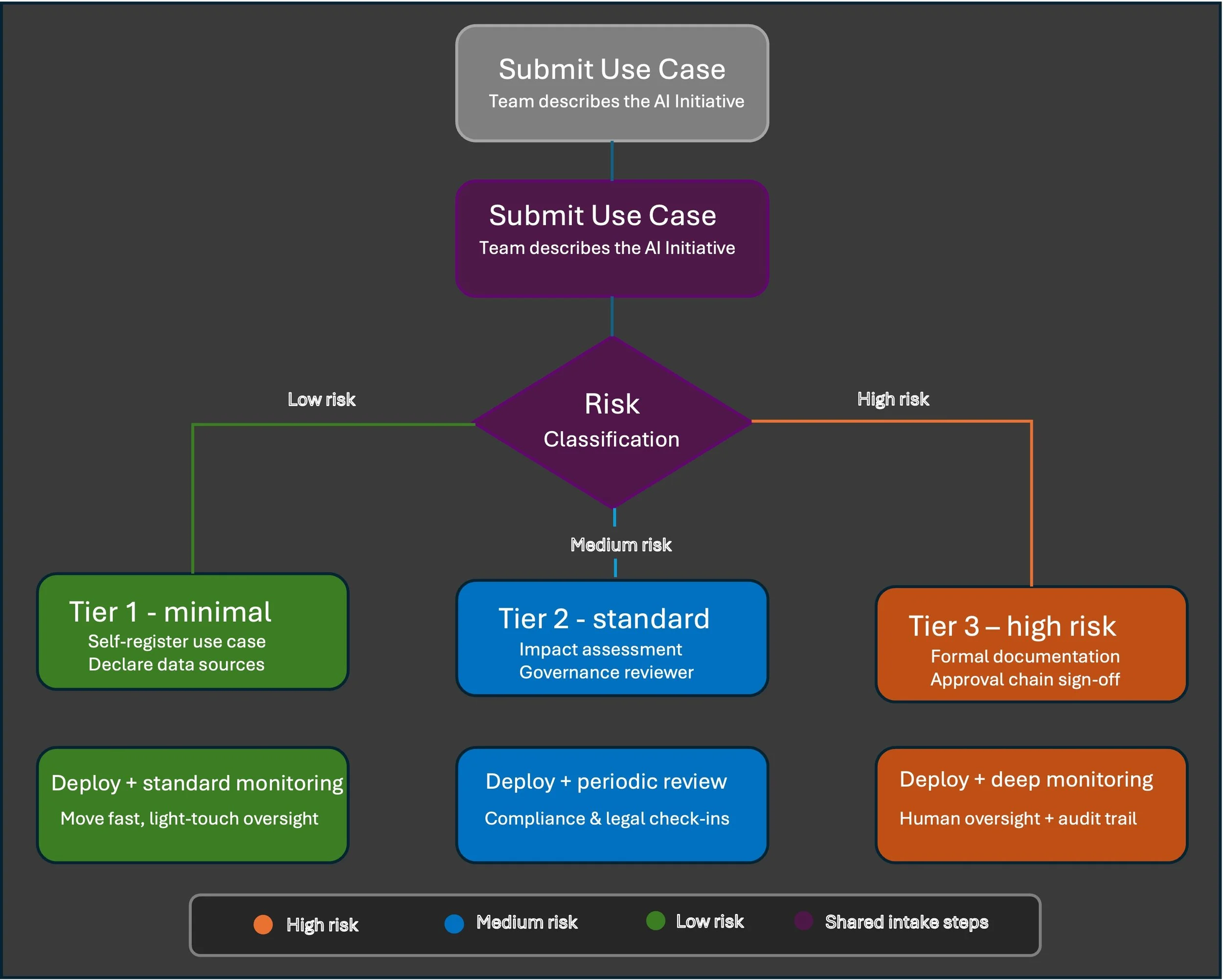
Here's the intake flowchart, tracking every use case from first submission to live deployment. The flow works like this:
Every AI initiative enters through the same front door — a structured submission that feeds a questionnaire capturing business purpose, data types, automation level, and oversight design. That information drives the classification diamond, where the use case gets sorted into one of three lanes.
From there the paths diverge meaningfully: low-risk tools self-register and move straight to deployment with standard monitoring; medium-risk cases get an impact assessment and at least one governance reviewer before going live; high-risk systems require formal documentation, an explicit approval chain, and commit to deep post-deployment monitoring with a human oversight requirement.